
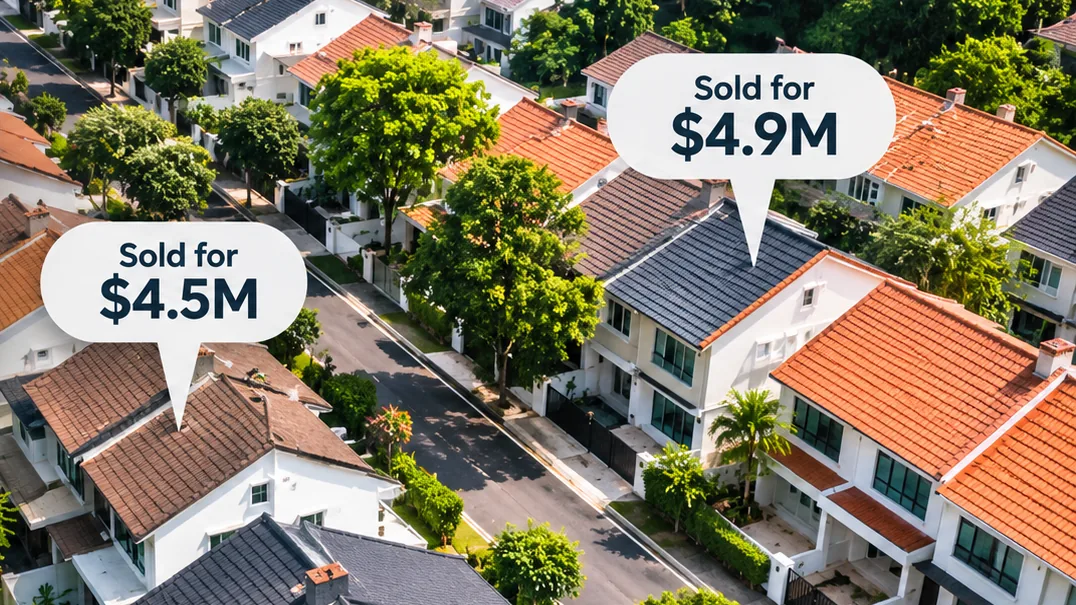
From understanding your home’s value to negotiating the right offer, here’s what every landed homeowner should know before putting their property on the market.
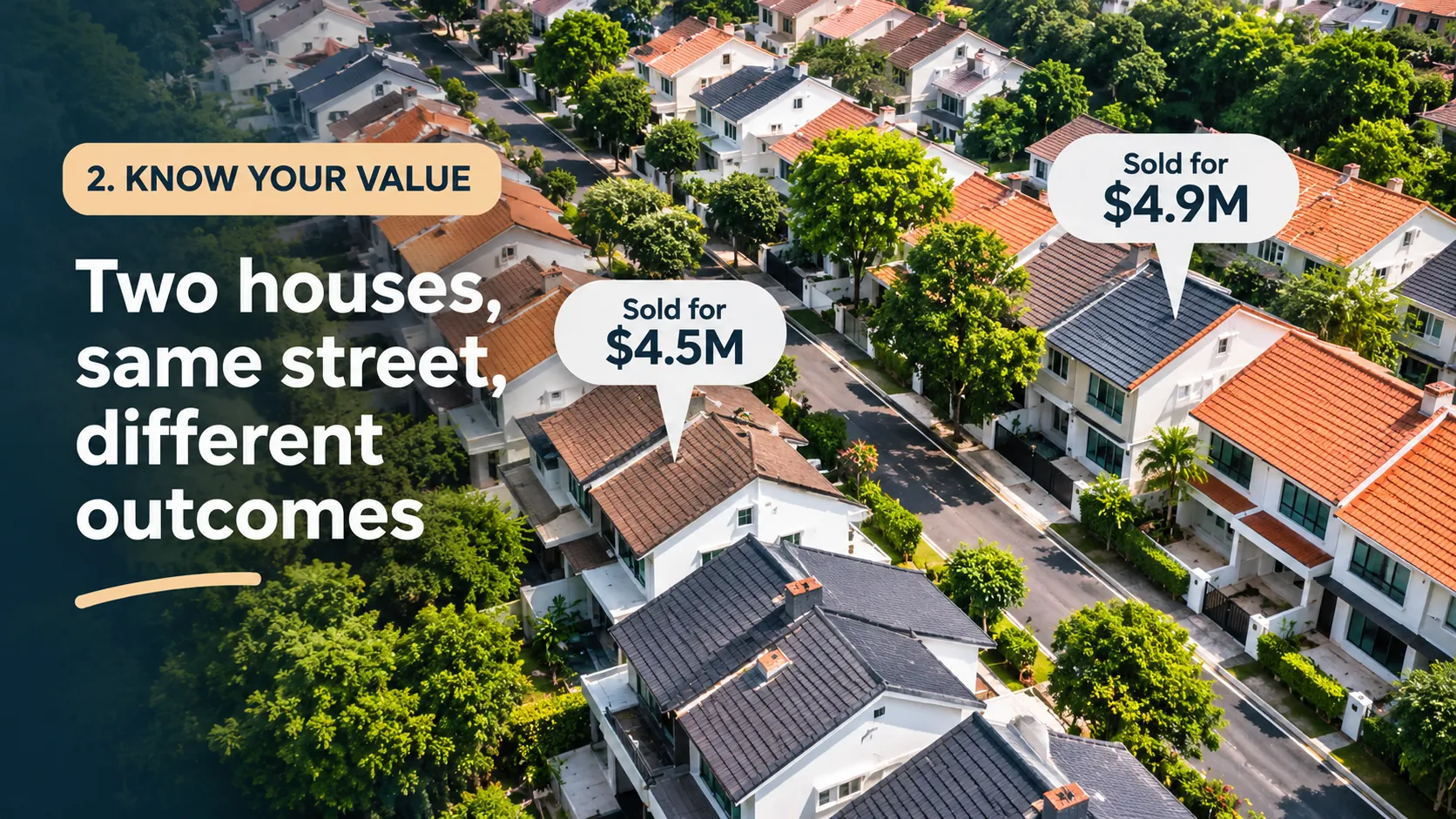
Imagine two landed houses along the same street.
Both have similar land sizes. Both are marketed within months of each other.
One sells for $4.5 million. The other achieves $4.9 million.
That’s a $400,000 difference.
Was the second seller simply luckier? Did the house have something special? Or did the owners approach the sale differently?
The answer could be a combination of all three.
Unlike condominium units, where comparable transactions are often available within the same development, landed properties are rarely so straightforward.
Even neighbouring houses can differ considerably in value because of their land configuration, frontage, building condition, location and redevelopment potential.
And when you’re dealing with a property worth several million dollars, getting these details right can make a meaningful financial difference.
So, before you put up that “For Sale” sign, here’s what you should know.
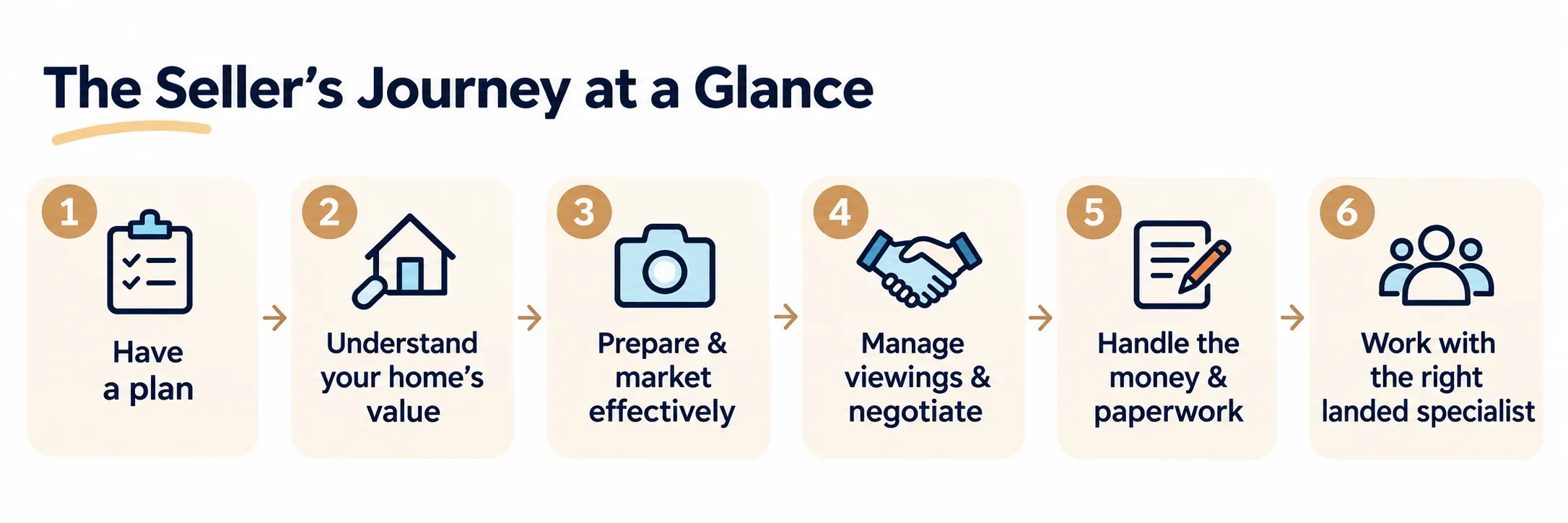
1. Before You Sell, Have a Plan

Most homeowners begin with the same question:
“How much can I sell my house for?”
It’s an important question, of course. But perhaps there’s a better one to ask first.
“What am I hoping to achieve from this sale?”
Are you upgrading to a larger home? Downsizing now that the children have moved out? Moving closer to family? Or simply considering whether it’s time to cash out on a property that has appreciated over the years?
Your reason for selling matters more than you might think.
Different sellers, different strategies
Consider two homeowners.
Seller A has already purchased another property and needs to sell within the next few months.
Seller B is perfectly comfortable staying put and will only move if someone makes an attractive offer.
Even if both properties are worth approximately $5 million, their selling strategies shouldn’t be identical.
Seller A may benefit from a competitive asking price designed to attract serious buyers within a shorter timeframe.
Seller B has greater flexibility and may be prepared to wait for a buyer who particularly appreciates the property’s unique attributes.
Neither approach is necessarily better. It depends on the circumstances.
Think beyond the selling price
Before marketing your home, it’s worth working through a few practical questions:
- How soon do you need to complete the sale?
- What are your estimated cash proceeds after repaying the mortgage, refunding CPF and settling expenses?
- Are you buying another property, and how will the transactions be coordinated?
- Would you need an extended completion period or temporary accommodation?
- What happens if your property takes longer than expected to sell?
These considerations influence everything from your asking price to how you evaluate an offer.
Our take: A good selling strategy isn’t simply about achieving the highest price. It’s about achieving the best outcome for your particular circumstances.
2. What Is Your Landed Property Really Worth?
Here’s where landed properties get interesting.
If you’re selling a condominium, you can usually refer to recent transactions within the development. Adjust for floor level, facing, condition and perhaps layout, and you’ll have a reasonable starting point.
With landed properties, it’s rarely that simple.
You might find a terrace house along your street that sold for $4.2 million, while another achieved $5 million.
Does that mean your house should be worth somewhere in between?
Not necessarily.
Why land PSF can be misleading
Price per square foot of land is one of the most commonly used measurements when comparing landed properties.
But relying on it alone can lead to some rather questionable conclusions.
Consider these hypothetical transactions:
| Property | Land area | Selling price | Land PSF |
|---|---|---|---|
| House A | 2,000 sqft | $4.0M | $2,000 |
| House B | 2,500 sqft | $4.5M | $1,800 |
| House C | 2,200 sqft | $4.84M | $2,200 |
At first glance, House C appears to have achieved the strongest price.
But what if House C was recently rebuilt, while House A was a 40-year-old property requiring extensive works?
And what if House B had an irregular plot configuration that limited its redevelopment possibilities?
Suddenly, those PSF figures don’t tell us very much on their own.
What actually influences landed property values?
Land configuration and frontage
Two plots with similar land areas can offer very different possibilities.
A regular-shaped plot with generous frontage may provide greater design flexibility than a larger but narrow or irregular site.
Building age and condition
A newly rebuilt house may attract buyers looking for a move-in-ready home, while an original-condition property may appeal to those planning a complete rebuild.
Interestingly, spending $500,000 on renovations doesn’t automatically increase your home’s value by $500,000.
Buyers may admire your imported marble flooring, but that doesn’t necessarily mean they’re prepared to pay extra for it.
Location within the estate
A house along a quiet residential street may appeal differently from one facing a busy road.
Accessibility, privacy, road width, nearby amenities and surrounding developments can all influence buyer preferences.
Redevelopment potential
For buyers planning to rebuild, the land’s development possibilities can be particularly important.
Applicable URA planning controls, building setbacks, allowable height, road reserves and other site-specific requirements may affect what can be constructed.
Potential subdivision or redevelopment opportunities should always be verified rather than assumed.
What about recent transaction data?
URA transaction records are a useful starting point, but they don’t tell the complete story.
Some landed streets have very few recent transactions. Others contain properties with vastly different characteristics.
Public caveat records may also be incomplete because caveat lodgement is not compulsory.
A proper market assessment therefore involves comparing relevant transactions, examining competing listings, understanding the property’s attributes and assessing current buyer demand.
Setting the right asking price
Here’s a common scenario.
A property has an estimated market value of approximately $4.5 million to $4.7 million.
The owner decides to advertise at $5.3 million, reasoning that there’s plenty of room to negotiate.
After all, buyers always bargain, right?
The problem is that many serious buyers may never arrange a viewing.
Today’s buyers have access to transaction data, competing listings and market information. Some have spent months viewing landed properties and know the market surprisingly well.
If your asking price is significantly higher than comparable alternatives without a compelling reason, buyers may simply move on.
Over time, a listing that receives little interest can become harder to market.
This doesn’t mean sellers should underprice their homes.
It means the asking price should be supported by market evidence, the property’s unique characteristics and a clear understanding of the target buyer.
Our take: Transaction data tells you what someone paid for another property. The real challenge is understanding what that transaction means for yours.
3. Preparing and Marketing Your Property

Should you renovate before selling?
It’s a question many homeowners ask, particularly when the house is showing its age.
The answer depends largely on who is most likely to buy it.
Understand your buyer before spending money
Imagine you’re selling a 30-year-old terrace house.
One potential buyer is a family looking for a comfortable home that requires only modest improvements.
Another buyer intends to demolish the existing structure and build a new house.
Would both buyers place the same value on a newly renovated kitchen?
Probably not.
For the first buyer, improvements to the property’s presentation and functionality may make a meaningful difference.
For the second, those expensive new kitchen cabinets may soon be heading to the skip.
This is why understanding your likely buyer should come before deciding how much to spend preparing the property.
Small improvements can make a big difference
If your property is being marketed as a move-in-ready home, presentation matters.
Simple improvements such as repainting tired walls, repairing defective fixtures, improving lighting, decluttering rooms and tidying outdoor spaces can make the home feel more inviting.
You don’t necessarily need a large renovation budget.
Sometimes, a clean and well-presented house is more appealing than an extensively renovated one with very specific design choices.
Marketing isn’t just about nice photographs
Professional photography is important.
But a marketing strategy should go beyond attractive pictures and a listing on a property portal.
Consider two different landed homes.
Property A A newly rebuilt semi-detached house with spacious bedrooms, modern finishes and a ground-floor ensuite bedroom.
Property B An original-condition terrace house on a regular plot in an established landed neighbourhood.
Both could be excellent properties, but they appeal to different buyers.
For Property A, the marketing might focus on lifestyle, practical family living and the convenience of moving in without major works.
For Property B, the emphasis may be on land attributes, location and redevelopment possibilities.
Marketing both properties using the same generic description would be a missed opportunity.
Reaching the right buyers
A comprehensive marketing campaign may involve property portals, video walkthroughs, social media, targeted digital advertising, agent networks and direct outreach to relevant buyer groups.
Each channel serves a different purpose.
Property portals reach active buyers already searching for homes.
Social media can introduce a property to people who may not have started searching but could be interested in the right opportunity.
Agent networks can connect sellers with buyers who have already expressed specific requirements.
However, generating more enquiries doesn’t automatically mean generating better enquiries.
A hundred people asking whether your $5 million house is negotiable to $3 million isn’t exactly the response you’re hoping for.
The objective is to attract financially qualified buyers who genuinely appreciate what the property offers.
Our take: Effective marketing isn’t about showing your home to everyone. It’s about presenting it to the people most likely to see its value.
4. From Viewings to Negotiations

You’ve launched your listing.
The photographs look great, advertisements are running and viewing appointments are coming in.
So far, so good.
But getting buyers through the door is only half the job.
Understanding buyer feedback
Landed buyers often have very specific requirements.
Some need a ground-floor bedroom for elderly parents. Others prioritise parking for multiple vehicles, generous outdoor spaces or sufficient room for a growing family.
A buyer upgrading from a condominium may focus on the layout and condition of the house.
Someone intending to rebuild may spend more time examining the plot dimensions than admiring the living room.
Understanding these motivations helps you interpret their feedback.
For example, if several buyers like the location but consistently raise concerns about the layout, that’s useful information.
If buyers appreciate the house but feel similarly priced alternatives offer better value, that may indicate a pricing or positioning issue.
Not every negative comment warrants a price reduction.
Some buyers will find fault with almost anything, especially when they’re preparing to negotiate.
The challenge is distinguishing genuine market feedback from ordinary bargaining behaviour.
The highest offer isn’t always the best offer
Let’s say you receive two offers.
Buyer A $4.8 million.
Buyer B $4.75 million.
Naturally, Buyer A appears more attractive.
But suppose Buyer A still needs to sell an existing property, has not secured financing and wants an unusually long completion period.
Buyer B, meanwhile, has financing arranged, is ready to proceed and offers a completion timeline that suits your plans.
Would you automatically choose Buyer A?
Probably not without understanding the risks.
An offer should be evaluated based on more than its headline price.
Important considerations include financing readiness, option terms, proposed completion date, special conditions and the buyer’s ability to proceed.
Negotiation is about understanding motivations
Many people think negotiation simply means countering with a higher number.
Buyer offers $4.5 million.
Seller counters at $4.8 million.
Eventually, everyone meets somewhere in the middle.
Sometimes, that’s exactly what happens.
But effective negotiation also involves understanding what matters most to the buyer.
Perhaps the buyer loves the property but is concerned about renovation costs.
Perhaps they need a particular completion date.
Or perhaps they’re deciding between your house and another property nearby.
Each situation calls for a different approach.
A buyer who feels confident about the property’s value and the transaction terms may be more willing to improve their offer.
Our take: The strongest negotiation isn’t necessarily the most aggressive one. It’s the one that understands where both parties see value and works towards terms that make sense.
5. Understanding the Money and Paperwork
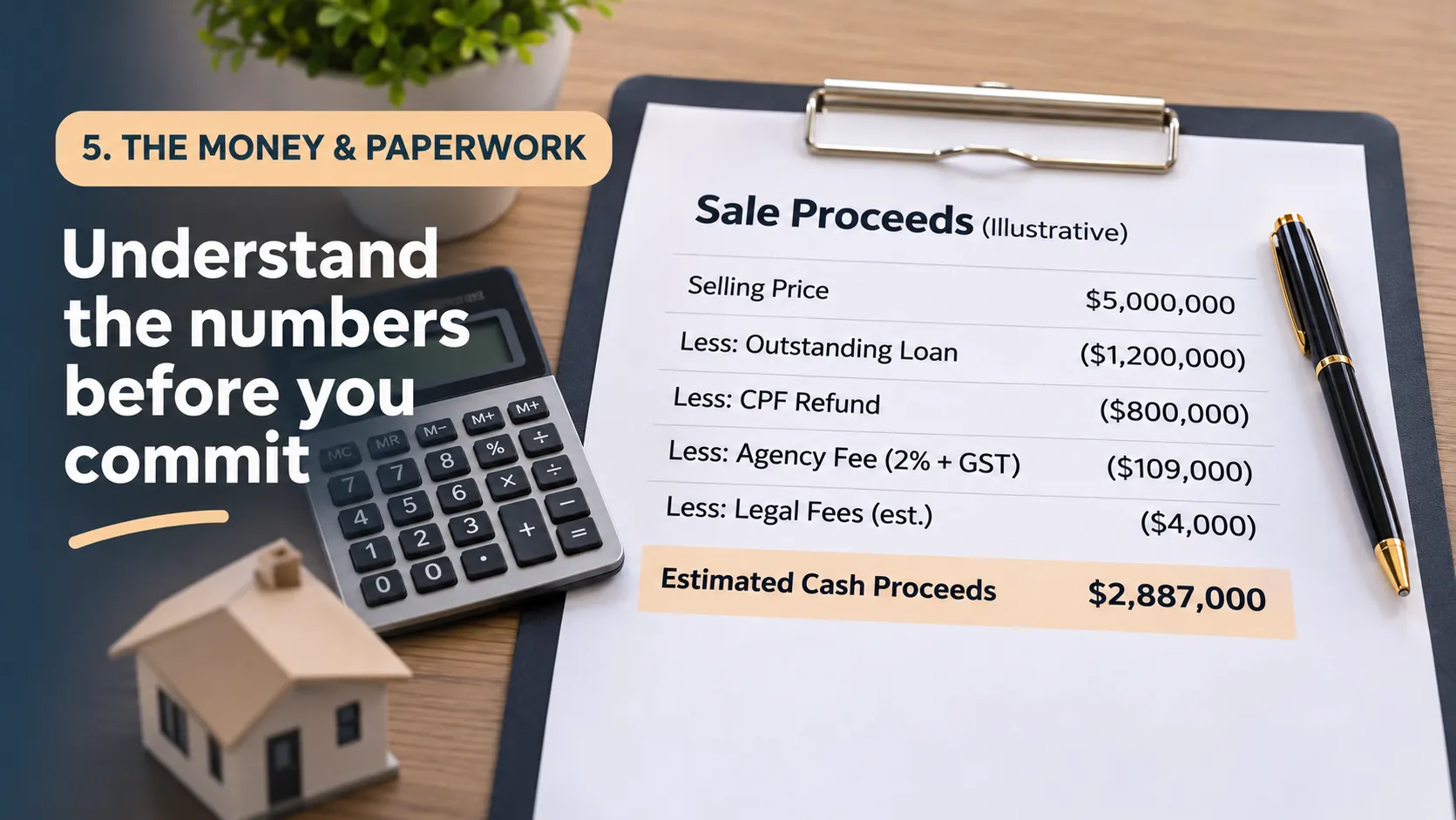
Selling your property for $5 million doesn’t mean you’ll receive $5 million in cash.
Before accepting an offer, you should have a clear understanding of the financial implications.
Seller’s Stamp Duty (SSD)
Depending on when you purchased your property and how long you’ve owned it, Seller’s Stamp Duty may apply.
For residential properties purchased on or after 4 July 2025, the SSD holding period is four years.
| Holding period | SSD rate |
|---|---|
| Up to 1 year | 16% |
| More than 1 year, up to 2 years | 12% |
| More than 2 years, up to 3 years | 8% |
| More than 3 years, up to 4 years | 4% |
| More than 4 years | 0% |
The duty is generally calculated on the higher of the selling price or market value, subject to applicable rules and exemptions.
Different SSD schedules may apply to properties purchased before 4 July 2025.
For a $5 million property, even a 4% SSD liability amounts to $200,000.
That’s certainly something you’d want to establish before committing to a sale.
CPF refunds
If CPF savings were used to purchase the property or service the housing loan, the amount withdrawn together with accrued interest generally needs to be refunded to CPF when the property is sold.
Owners aged 55 and above may have additional considerations involving their Retirement Account and applicable CPF housing rules.
CPF refunds aren’t a tax, but they can significantly affect the amount of cash you receive.
How much cash will you actually receive?
Consider this simplified example:
| Item | Amount |
|---|---|
| Selling price | $5,000,000 |
| Outstanding housing loan | ($1,200,000) |
| CPF refund | ($800,000) |
| Agency fee, assumed 2% plus 9% GST | ($109,000) |
| Estimated legal fees | ($4,000) |
| Estimated cash proceeds | $2,887,000 |
That’s quite a difference from the original $5 million selling price.
If you’re planning to buy another property, understanding your available cash and CPF funds becomes even more important.
Depending on your circumstances, you may also need to consider financing, bridging arrangements, stamp duties and the timing of your next purchase.
From offer to completion
Once the selling price and terms have been agreed upon, the transaction generally moves to the Option to Purchase (OTP) stage.
For a typical private residential resale, the seller grants an OTP, and the buyer must exercise it within the agreed period.
A commonly used arrangement involves a 1% option fee followed by a further 4% upon exercise, although the actual terms depend on the contract.
After exercise, both parties’ conveyancing lawyers handle the legal process leading to completion.
Private residential resale transactions commonly provide around 8 to 12 weeks from exercise to completion, but the period is negotiable.
Watch out for potential complications
For landed properties, it is worth checking matters that could affect the transaction, including:
- Outstanding mortgage obligations and CPF refunds
- Existing tenancies or vacant possession arrangements
- Ownership and title matters
- Alterations and additions requiring regulatory approval
- Discrepancies between existing structures and approved plans
- Any applicable restrictions or conditions affecting the property
Not every renovation requires the same approvals, and the requirements depend on the nature of the works.
Where necessary, qualified professionals should review the relevant records and advise on compliance.
Discovering a potential issue before marketing the property is usually much easier than trying to resolve it after a buyer has exercised the OTP.
Our take: A successful sale isn’t just about agreeing on a price. It’s about ensuring the transaction can proceed smoothly and that the proceeds support your next move.
6. Why the Right Landed Specialist Matters

There’s no shortage of property agents in Singapore.
And many are capable of arranging viewings, advertising listings and handling the administrative aspects of a sale.
But landed properties come with their own set of considerations.
Understanding land configuration, redevelopment potential, buyer preferences and the differences between seemingly comparable properties can make a meaningful difference to how a home is positioned and marketed.
What should you look for in a landed property agent?
Before appointing an agent, consider asking these questions. (We go deeper on this in How to Choose a Landed Property Agent in Singapore.)
How did you arrive at your recommended asking price?
A credible recommendation should be supported by relevant transactions, competing listings and the property’s individual characteristics.
Who is the most likely buyer for my property?
An agent should be able to explain whether the property is more likely to appeal to buyers seeking a move-in-ready home, those planning alterations and additions, or those considering a rebuild.
What makes my property different from competing listings?
Every landed home has strengths and weaknesses.
An effective marketing strategy should recognise both rather than relying on generic selling points.
What happens if the initial response is weaker than expected?
A thoughtful approach involves reviewing enquiry quality, buyer feedback, marketing performance and pricing before making changes.
How will you help me evaluate and negotiate offers?
Attracting buyers is important, but converting genuine interest into a successful transaction requires judgement and experience.
Beware of choosing an agent based purely on the highest valuation
Imagine meeting three agents.
The first suggests your property could sell for $4.6 million.
The second recommends $4.7 million.
The third confidently announces that your house is worth $5.2 million.
Naturally, the third agent sounds rather appealing.
But before getting too excited, ask how that figure was derived.
Is it supported by comparable transactions? Does the property have characteristics that justify a premium? Is there evidence of buyer demand at that price level?
Or is it simply a number designed to win your appointment?
A higher asking price doesn’t automatically translate into a higher selling price.
In some cases, unrealistic pricing can lead to prolonged marketing, repeated price reductions and weaker negotiating positions.
A good agent should be prepared to explain their assessment, including the limitations and uncertainties involved.
Specialisation matters, but so does the strategy
A landed specialist should bring more than knowledge of property types and planning terminology.
They should understand how different buyers evaluate landed homes, which property attributes matter most, how to position the house against competing options and how to navigate the negotiation process.
Just as importantly, they should take time to understand your circumstances.
After all, the objective isn’t simply to sell a property.
It’s to help you make a well-informed decision and achieve an outcome that supports your plans.
Final Thoughts: Selling Well Starts With Planning Well
Every landed property is different.
Some are best marketed as beautiful family homes ready for immediate occupation.
Others appeal to buyers who see potential in the land and what they could eventually build.
Understanding that difference is often the starting point of a successful sale.
Pricing, presentation, marketing and negotiation all play important roles. But they shouldn’t be approached independently.
They need to work together as part of a coherent strategy.
If you’re considering selling your landed home, begin by understanding its position in today’s market, the buyers most likely to appreciate it and what you ultimately hope to achieve.
Because selling a house is one thing.
Selling it well is another.
The next step
Thinking of selling your landed property?
At HouseHunt.sg, we believe every landed home deserves a selling strategy built around its individual characteristics, not a generic marketing package.
Whether you’re ready to sell or simply exploring your options, our landed specialists can help you understand recent transactions, competing properties and a realistic market range for your home.
Speak to our landed specialists for a personalised property assessment.
No obligation. No pressure. Just a clearer picture of where you stand.
If you’re selling
What your house is actually worth
Send the address. You’ll get the last transacted prices on your street and a realistic range for your house, before any conversation about listing it, and with no obligation to list it with us at all.
Rather just message? WhatsApp us
28 Singapore districts coveredReplies from Clarry or Gavan, personallyLicensed CEA R017311A, R055759I
Frequently Asked Questions
How is Seller’s Stamp Duty calculated when I sell a landed house in Singapore?
For residential properties bought on or after 4 July 2025, Seller’s Stamp Duty applies if you sell within four years of purchase: 16% in the first year, 12% in the second, 8% in the third and 4% in the fourth. It is generally calculated on the higher of the selling price or market value. Properties bought between 11 March 2017 and 3 July 2025 follow the earlier three-year schedule of 12%, 8% and 4%, so check which schedule applies to your purchase date.
How long does it take from accepting an offer to completion?
For a typical private resale, the buyer pays an option fee (commonly 1%) for the Option to Purchase and exercises it within the agreed period, often 14 days, with a further 4%. Completion commonly follows around 8 to 12 weeks after exercise. Both periods are negotiable, so the whole process often takes about two to three months.
Do I need to refund my CPF when I sell my landed property?
Yes. If CPF savings were used for the purchase or the housing loan, the amount withdrawn plus accrued interest generally goes back into your CPF account when you sell. It is not a tax, since the money returns to your own CPF, but it reduces the cash you receive from the sale. Owners aged 55 and above may have additional considerations involving their Retirement Account.
Should I renovate my landed house before selling it?
It depends on who is most likely to buy it. A buyer looking for a move-in-ready home may value repairs, fresh paint and better presentation. A buyer planning to rebuild will place little value on a new kitchen. Spending $500,000 on renovations does not automatically add $500,000 to your selling price, so understand your likely buyer before spending money.
Is land price per square foot a reliable way to value my landed home?
Only as a starting point. Two plots with the same land PSF can differ widely in value because of frontage, plot shape, building age and condition, location within the estate and redevelopment potential. A proper assessment compares relevant transactions, competing listings and current buyer demand alongside the property’s own attributes.
Clarry Au is a Singapore landed property specialist and Co-Founder of HouseHunt.SG, operating within PropNex’s Eminence Landed. He has spent around 15 years helping landed homeowners and buyers make well-informed decisions, built on transparency and district-level market knowledge. Reach him at clarryau.com or via WhatsApp.
Clarry Au, CEA R017311A · PropNex Realty Pte Ltd, CEA L3008022J
Related reading on HouseHunt.SG: